

“Royalty-free” is one of the most misunderstood phrases in music licensing. Many people assume that if a track is royalty-free, it is automatically free to use for any commercial purpose. That is however, not always the case. The terms of a royalty-free licence still determine how, where and by whom the music can be used.
Now imagine this, you get the brief, your creative team comes up with a concept and everyone agrees the campaign needs music. Someone eventually finds the perfect track. It fits the brand and the campaign like bread and butter, even the client loves it.
Then comes the question that can change everything:
Can we actually use it?
Finding the right track for an advert is one thing, securing the right to use it is another. This distinction is important because advertising has moved well beyond television and traditional media into paid social, creator campaigns, YouTube, streaming platforms and increasingly AI-assisted content production. A campaign that starts as one commercial can quickly become a whole ecosystem of content, with each use potentially raising its own licensing considerations.
A 30-second TV commercial might become a six-second YouTube cutdown, a paid Instagram ad, a TikTok campaign, creator content, a website film and several other versions. Having permission to use a track in one context does not necessarily mean that permission covers all of them.
So before you build an entire campaign around a song, let’s look at what music licensing for advertising actually involves.
What is music licensing?
Music licensing is the process of obtaining permission to use copyrighted music for a specific purpose. For advertising, that means determining what music you want to use, how you plan to use it, where the campaign will run, how long it will run and who will be using it.
When an existing recording is paired with visual content, there can be separate rights in the musical composition and the sound recording. These are commonly addressed through sync and master-use licensing respectively.
In simple terms, the sync licence relates to putting the music together with your visuals, while the master-use licence relates to using the particular recording itself. Depending on the track and the way it will be used, you may need permission from different rights holders.
In simple terms, sync covers the use of the music with your visuals, while master-use covers the particular recording. Depending on the track, you may need permission from different rights holders.
So, finding or downloading a song does not automatically give you the right to use it in an advert. The rights you need depend on how the music will be used.
Under Nigeria’s Copyright Act 2022, both musical works and sound recordings are protected works. For marketers, the practical takeaway is that before a track goes into a campaign, make sure the appropriate rights have been identified and cleared for the intended use.
How much time does the music licensing process take?
The timeline depends on the track, rights holders, territories, media and campaign scope. Popular commercial recordings can require more extensive clearance and negotiation.
Spring Sound’s African music library includes a growing selection of one-stop tracks, allowing brands and agencies to spend less time searching for multiple rights holders and more time moving the campaign forward.
How much does music licensing cost?
There is no fixed price for advertising music. Licensing fees depend on the music selected, campaign duration, territories, platforms and rights required.
At Spring Sound, we consider the campaign scope and recommend a licensing route that fits the intended use and budget.
Can you use any song in an advert?
Not necessarily. A song may be available on Spotify, YouTube, Instagram or TikTok and still require separate permission for commercial audiovisual use. Being able to find or access a song does not automatically mean you have the right to use it in an advert.
Social platforms are a good example. TikTok’s Commercial Music Library is specifically designed for businesses using music on TikTok. Its July 2026 guidance says businesses should select the region where their campaign will run and choose music based on permitted placements. Commercial Sounds can then be used for organic or paid TikTok content but that permission is specific to the use covered by the platform. It does not automatically mean that the same track is cleared for a television commercial, YouTube campaign, cinema placement or another advertising environment.
Platform availability is not the same thing as campaign-wide music clearance. That is why music licensing needs to be considered alongside the media plan from the beginning, rather than after the creative has already been built around the track.
How to License Music for an Advertising Campaign in Nigeria
Licensing music becomes much easier when it is considered from the start of the campaign. Here’s what the process can look like with a music supervision partner like Spring Sound:
1. Start with the brief
Define the campaign’s audience, creative direction, platforms, territories, duration and expected versions. At Spring Sound, we use this to understand exactly what the music needs to achieve creatively and commercially.
2. Find the right music
Depending on the brief, this could mean an existing commercial recording, production music or original music. Spring Sound can source from its extensive African music catalogue and wider industry network to find music that fits the campaign and its cultural context.
3. Clear and negotiate the rights
Once the music is selected, we identify the relevant rights holders and negotiate licensing terms based on the campaign’s intended use, including platforms, territories and duration. With 600+ tracks in our African music library available for one-stop clearance, Spring Sound gives brands and agencies a simpler route to licensed African music, without having to manage multiple rights conversations themselves.
4. Manage the process
Spring Sound manages the moving parts, coordinating artists, rights holders, agencies and production teams through to final clearance. You get one specialist partner, one streamlined process and music that is ready to use.
What does a music licence for an advert need to cover?
- Where the music campaign will run
- Territories covered
- How long the music will be used
- Who owns the relevant rights
- How the music will be edited
- If it is allowed for AI use
3 ways to soundtrack an advertising campaign
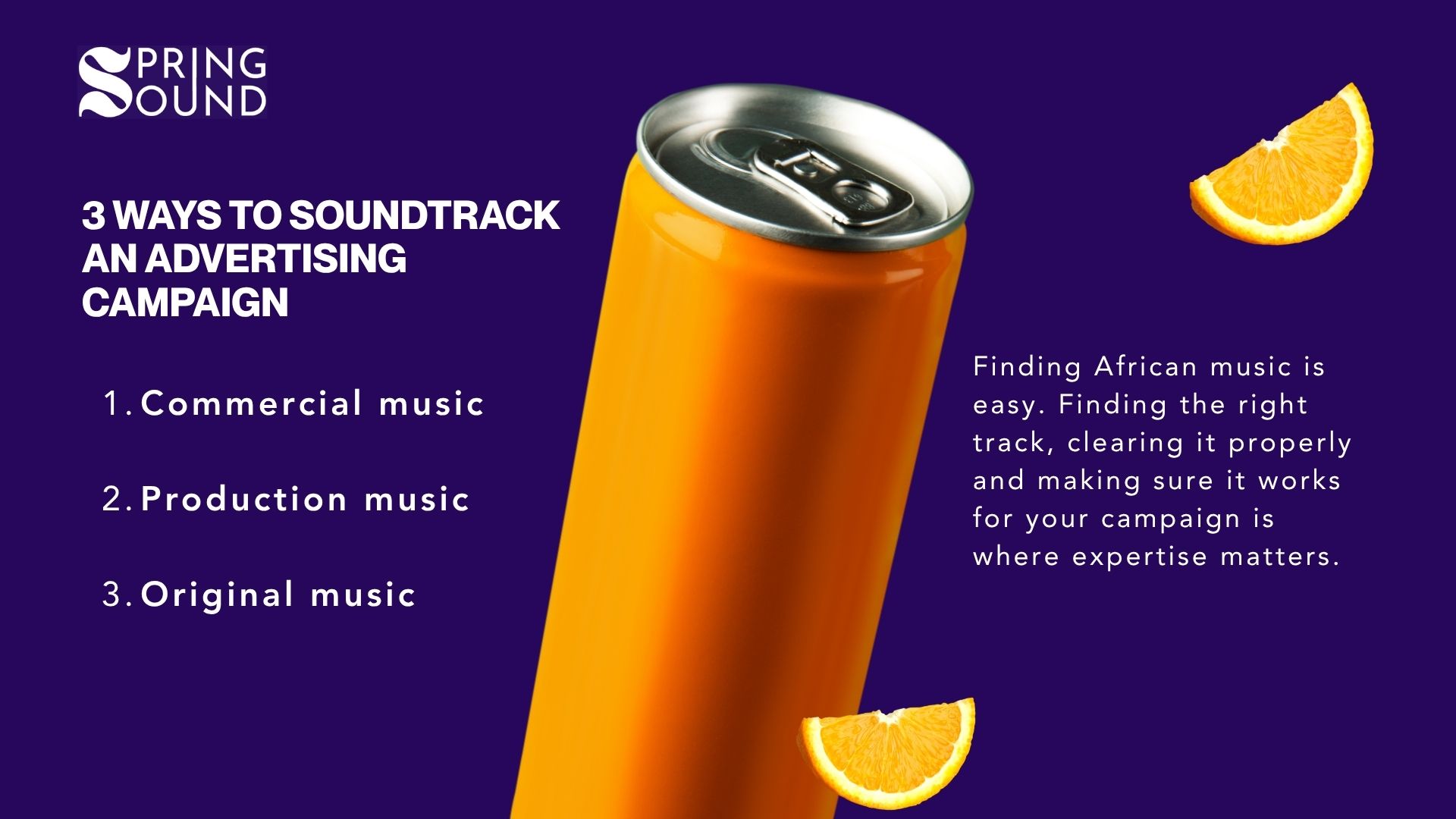
- Existing commercial music
The right released track can give a campaign instant familiarity, emotion or cultural relevance.
The challenge is making sure the necessary rights can be secured for the intended use.
- Production music
Production music can offer a practical route when a campaign needs music designed for audiovisual use with a clear licensing framework. It can also be useful when multiple versions, edits or quick turnaround are required.
- Original music
Sometimes the right track for that project might not exist yet. Original music can be composed specifically around the campaign, giving the creative team control over the mood, structure, sound and relationship between music and picture.
The question however, is not which option is universally better but which one works best for the campaign.
Need African Music for Your Next Advertising Campaign?
Finding African music is easy. Finding the right track, clearing it properly and making sure it works for your campaign is where expertise matters.
Spring Sound is an African music supervision and licensing company based on the continent, with a 4,000+ track African music library and a network spanning artists, rights holders and music professionals across the region.
Our music supervisors bring experience across major African film, television and advertising projects, including work connected to Amazon Studios, Netflix, Paramount+ and major global brands such as Red Bull.
Need a Nigerian hit, an emerging African sound or a culturally specific recording, we can help you source it, supervise it and secure the rights to use it.
Need African music for your next campaign? Speak with Spring Sound.
1 Comment
[…] A brand that wants to promote a creator’s organic post as a paid advert, reuse it on another platform or incorporate it into a wider campaign must check whether the existing permissions cover those uses. Depending on the intended use, clearance may need to cover both the musical composition and the sound recording. Platform permissions alone may not be sufficient, particularly when content is repurposed beyond TikTok. […]